 Merlinswap
 liquidity positions hold one token outside their selected price range
Updated on
Merlinswap liquidity supports swaps inside a selected price range and becomes single-token liquidity when the pool price moves beyond that range. The remaining token depends on which boundary the price crosses and how the pair quotes its price. Ordinary range liquidity can participate again if trading brings the price back within its selected boundaries.
Merlinswap uses iZiSwap’s concentrated liquidity design on Merlin Chain. A position’s range determines where its tokens can meet incoming swaps. Understanding that range also separates trading fees, token composition and farm incentives, which respond to different conditions.
Pool price and range limits determine the token mix
A liquidity position combines a token pair with lower and upper price boundaries in a particular pool. Its trading inventory changes as swaps move through those boundaries. iZiSwap distributes the position across discrete price points within the chosen interval. The current pool price identifies the point where trading takes place.
The model names the two tokens tokenX and tokenY. With price expressed as tokenY per tokenX, points below the current price hold tokenY, while points above hold tokenX. Both tokens may exist at the current point. Reading a position therefore requires its quote direction as well as its boundaries. Reversing the displayed pair changes how the price reads, so words such as higher need that context.
What happens when the pool price leaves my range?
Once trading carries the current pool price outside the selected interval, the position stops supplying liquidity at the active price. An ordinary range position holds only one pool token when the pool price lies outside its range.
Using tokenY per tokenX as the price, a position entirely above the current pool price holds tokenX. This corresponds to a market price below its lower bound. A position entirely below the market holds tokenY, because the pool price has crossed its upper bound.
That conversion concerns the inventory supplying swaps inside the position. Separately recorded fees or incentives have their own balances. A one-token position therefore does not establish the token mix of the whole wallet.
A range exit changes trading inventory. A price crossing alone does not return the assets to the wallet, because the position still commits them to the pool.
Narrow and wide ranges distribute liquidity differently
When two ranges surround the same pool price, allocating equal capital to the narrower interval concentrates liquidity across fewer price points. Moving both boundaries outward spreads that capital across a broader span. This width comparison keeps the token pair, fee setting and starting price unchanged.
Moving both boundaries outward also increases the price movement required to leave the interval in either direction. This changes how far a position can keep participating as the pool price moves. It does not establish a future fee total. Incoming swap volume and other active liquidity determine the trading activity the position actually serves.
Price points separate local execution from price movement
At a single iZiSwap price point, available liquidity trades at that point’s defined exchange price until the required token runs out. A larger swap can continue into additional points, each carrying its own price. The average execution price then reflects the quantities taken across the points it reaches.
This explains how local constant-sum execution coexists with price movement across a pool. Fixed-price execution at one point does not make an entire multi-point trade price invariant. Successive trades alter the position’s token inventory as they consume liquidity. Pool liquidity totals also include capital at other prices. A large total alone cannot reveal the depth immediately available to a swap.
Swap fees and farm incentives measure different activity
An out-of-range position supplies no liquidity at the current trading point, so current swaps cannot generate new trading fees for that position. Fees from earlier participation concern an earlier balance; they do not imply the range remains active.
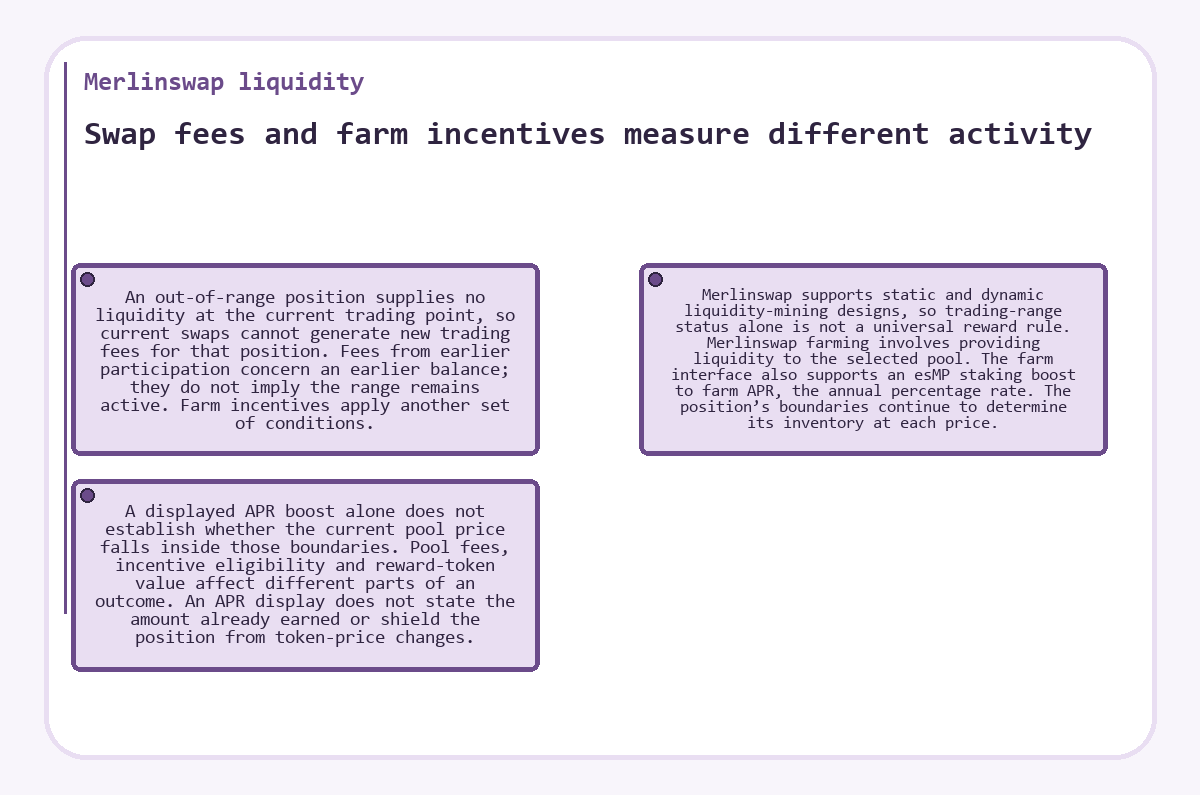
Farm incentives apply another set of conditions. Merlinswap supports static and dynamic liquidity-mining designs, so trading-range status alone is not a universal reward rule. Merlinswap farming involves providing liquidity to the selected pool.
The farm interface also supports an esMP staking boost to farm APR, the annual percentage rate. The position’s boundaries continue to determine its inventory at each price. A displayed APR boost alone does not establish whether the current pool price falls inside those boundaries.
Pool fees, incentive eligibility and reward-token value affect different parts of an outcome. An APR display does not state the amount already earned or shield the position from token-price changes.
Position value follows the remaining token inventory
Impermanent loss compares a liquidity position’s value with holding the original token amounts outside the pool over the same price movement. Trading changes the quantities the position holds, which makes this comparison relevant even before a withdrawal. Both alternatives need the same valuation basis.
Single-token composition does not quantify that difference. Token prices determine the value of the remaining inventory, while earned fees and incentives contribute separate amounts. A position can gain value in one currency and still trail the original tokens held outside the pool. Calling the difference impermanent does not make recovery automatic. The comparison uses the actual asset quantities and the same valuation time, without treating a displayed APR as realized proceeds.
Can an ordinary position trade again after the price returns?
Yes, an ordinary position can supply swaps again when the current pool price re-enters its range, provided the liquidity remains deposited. The range itself does not follow the market automatically. Its unchanged boundaries describe the same set of price points throughout that price excursion.
Re-entry describes renewed access to the position’s liquidity. It does not establish that the original token quantities have returned or that a previous valuation gap has closed. Those outcomes depend on the price path and subsequent trades. Incoming swaps and available liquidity determine whether the pool price reaches those points again.
Liquidity records and farm status show different states
A successful liquidity addition produces a position visible in the liquidity view. Its pool and range identify what the deposit supplies. Farm information adds another state: the farming indicator shows mining participation. The farm panel also displays NFTId, the liquidity position’s non-fungible token identifier, alongside APR. A position identifier alone does not establish that the position still has positive liquidity.
The liquidity manager separately records the liquidity quantity and token balances owed to the position. Those fields distinguish capital still deployed from amounts available for collection. A range crossing changes trading participation without itself proving that collection occurred. A wallet balance increase and an active-range status describe different events.
Prerequisites for range positions, farms and orders
With prices expressed as tokenY per tokenX, the range’s location determines which inventory it requires. Narrower and wider in-range positions share that pricing model. Farm participation and an esMP boost add their own requirements. A limit order commits liquidity at one target point.
| Liquidity choice | Required assets or conditions |
|---|---|
| Narrower range around the current price | Pool-token amounts matching that interval and permitted endpoints. |
| Wider range around the current price | Pool-token amounts covering the broader interval and permitted endpoints. |
| Range entirely above the current price | TokenX, with price expressed as tokenY per tokenX. |
| Range entirely below the current price | TokenY, with the same quote direction. |
| Farm liquidity without an esMP boost | A liquidity contribution to the selected farm pool under its incentive rules. |
| Farm liquidity with an esMP boost | Eligible farm liquidity plus esMP staked through the boost feature. |
| Limit-order liquidity | The token to exchange at the selected price point and incoming swaps able to fill it. |
| Shared requirement | Match the token commitment to the selected range or order and any applicable farm conditions. |
A single-token starting position can reflect a range deliberately away from the current price. Its inventory alone does not reveal whether trading left a previously active range or has never entered it.
Range liquidity and limit orders leave different exit positions
An iZiSwap limit order supplies one-time liquidity at its selected price point. Incoming swaps must consume that liquidity for execution to occur. After an order fills completely, a later reversal does not turn its proceeds back into the starting token. The order provider must claim the traded tokens. Ordinary range liquidity can resume exchanging in either direction when trading revisits its covered points.
What to know about Merlinswap liquidity
Does touching either boundary count as being in range?
iZiSwap includes the lower tick boundary and excludes the upper tick boundary. With lower index l, upper index r and current index i, a position covers l ≤ i < r. Reaching the upper endpoint places the current tick outside that interval, while reaching the lower endpoint does not.
Why can i not choose every tick as a range endpoint?
Permitted range endpoints follow the pool’s spacing rules. The iZiSwap range model includes a 0.2% pool configuration requiring both endpoint indices to be multiples of 40. Those values describe that configuration; they do not establish every Merlinswap pool’s fee or spacing. A decimal price alone does not determine endpoint validity.
Are equal liquidity values the same as equal token balances?
Equal liquidity values at different iZiSwap price points do not imply equal token quantities. The model defines liquidity as L = x√p + y/√p, where x and y are the token amounts at price p. Because p enters the expression, identical L values can correspond to different inventories.
Can positions for the same token pair show different range statuses?
Positions for the same pair can show different statuses because their ranges or pools can differ. iZiSwap identifies a pool by its two token contract addresses and fee parameter. Different fee settings can therefore distinguish pools with their own current prices. Even within one pool, different selected boundaries can leave one position active while another lies outside its range.
Where do the tokens in my liquidity position reside?
The core pool contracts hold the tokens supplying swaps in iZiSwap’s architecture. Periphery contracts provide user operations and retain some control over assets. An out-of-range position remains subject to that contract structure even when its liquidity cannot serve swaps at the current price.
Does collecting fees remove the underlying liquidity?
A successful collection through LiquidityManager leaves the position’s liquidity quantity unchanged. The contract separates decreasing liquidity from collecting amounts owed. A collection may contain principal from an earlier liquidity decrease as well as fees. Those token balances therefore differ from the liquidity still committed to the range.
When can an empty liquidity NFT be burned?
The LiquidityManager contract allows an authorized caller to burn a position NFT only when its liquidity and both remaining token balances equal zero. An out-of-range position can still have a positive liquidity quantity. Range inactivity alone therefore does not make an NFT eligible for burning.